Rugby Positions and Player Roles
The Forwards: The Engine Room
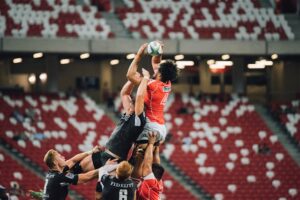
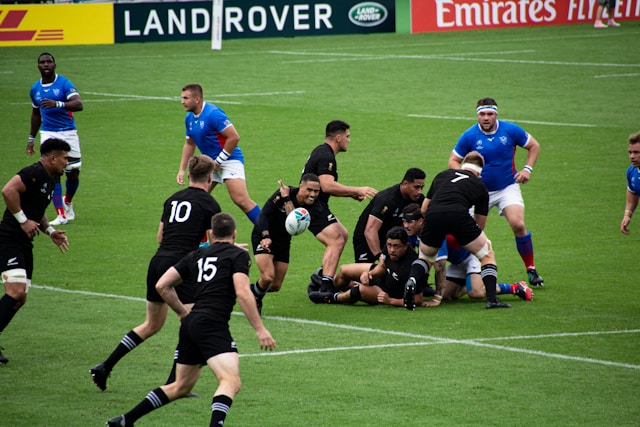
A rugby team consists of eight forwards (numbered 1 to 8) and seven backs (numbered 9 to 15). The main role of the forwards is to gain and retain possession of the ball. They take part in set pieces—the scrum and the lineout. Generally, forwards are larger than backs, which makes them stronger but slower. Forwards also have a role in taking the ball forward, generally by driving into the opposing forwards.
The Front Row (1, 2, 3)
The Second Row (4, 5)
| Position | Number | Role |
|---|---|---|
| Lock | 4 & 5 | Typically the largest players; provide power in scrums and secure ball in lineouts |
The Back Row (6, 7, 8)
Collective terms for forwards include: “Front Five” or “Tight Five” (props, hooker, and locks), “Back Row” (flankers and Number 8), and “Pack” (all forwards bound for a scrum).
The Backs: The Playmakers
The role of the backs is to move the game forward by running or kicking the ball. The fly-half controls how this is done. The backs tend to score more tries. They tend to be smaller than forwards and as a result more agile and faster, but less strong.
The scrumhalf and fly-half together form the “half-backs,” while the centers and fly-half form the “midfield.” The wingers and fullback are collectively known as the “back three” or “outside backs”.
Positional Variations and Naming
There is considerable variation in position names globally. For example, in New Zealand, the fly-half is referred to as the “First 5/8th,” implying a slightly deeper position than half-back, and the inside centre as the “Second 5/8th”. In Australia, the second row is often called “secondrow,” the position behind them as “lock,” and the fly-half as “five-eighth”. Despite World Rugby’s standardized naming, alternative names remain common.